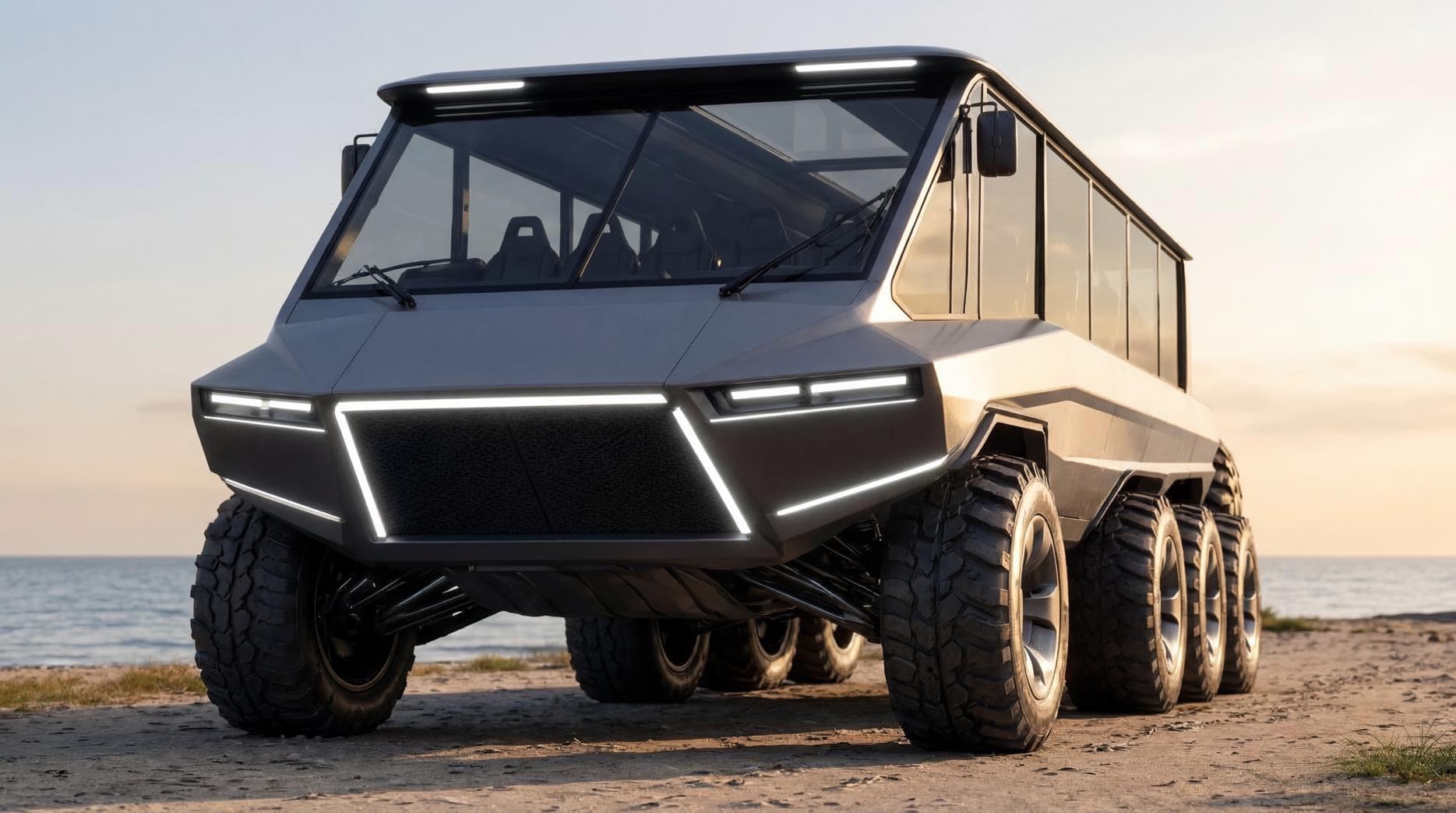
Design study
A concept vehicle for San Diego SEAL Tours.
A first look at our design study for the next-generation amphibious tour craft — and what it says about where dual-environment vessels are headed.
By Nautilus Industrial MarinePublished Updated
For years, Nautilus crews have kept the San Diego SEAL Tours fleet running — fitting, fabricating, and refurbishing vessels that live a double life on pavement and in salt water. Few machines work harder. And few machines make the case for modernization more clearly.
Legacy amphibious tour vehicles are built on designs that date to the 1970s: steel hulls, diesel combustion, analog instrumentation. They are loud, maintenance-hungry, and increasingly out of step with the emissions standards taking shape across California harbors. Operators feel it in unplanned downtime; guests feel it in vibration, noise, and diesel smell.
So we asked a simple question: what would this vehicle look like if you designed it today, from a clean sheet?
Purpose-built, not adapted.
The result is a design study for an all-electric, purpose-built amphibious platform. Not a converted truck, not a re-engined legacy hull — a lightweight amphibious architecture engineered from the keel up for both land and sea.
We developed the concept over three years in collaboration with marine engineers, battery technology experts, and amphibious vehicle specialists. Every component — from buoyancy calculations to corrosion-resistant hull integration — was optimized for the unique stress of operating in two environments, where salt-water corrosion meets road vibration.
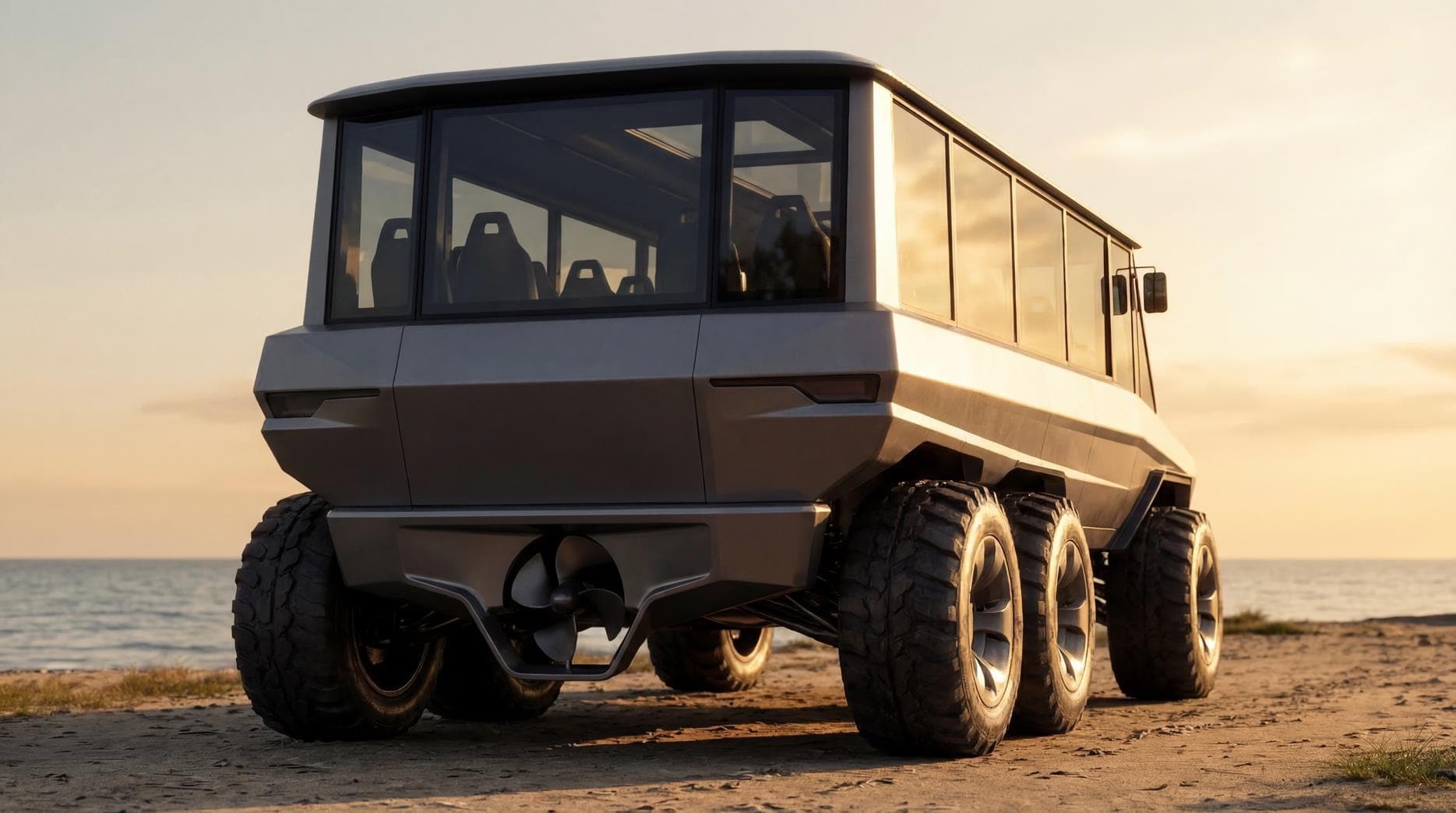
Engineered for two environments.
Safety drove the architecture. The powertrain pairs proven electric marine propulsion with redundant battery systems — independent dual-drive for road and water, engineered so the vessel remains operational and maneuverable even if a system fails.
The high-voltage architecture is sealed to marine-grade IP67/69K standards, with active isolation monitoring to prevent water intrusion and electrical faults. Batteries sit low in the hull, improving stability over legacy diesel configurations, and regenerative braking paired with modern disc brakes shortens stopping distances significantly. Continuous telemetry watches battery health and system status in real time, turning maintenance from reactive to predictive.
For guests, the difference is immediate: quiet, zero-emission operation, modern egress systems, and sightlines designed around the ride instead of around a diesel engine.
Built for salt.
Salt water is the quiet killer of amphibious fleets, so corrosion protection is designed in rather than painted on. The structure is 5086/6061 marine-grade aluminum with multi-layer epoxy barrier coats and sacrificial zinc anodes on the hull exterior. Hardware is 316 stainless; wheels are hard-anodized aluminum; suspension joints ride in ceramic-sealed, triple-lip bearings with marine-grade EPDM rubber throughout.
The platform also defends itself. An automated freshwater rinse system flushes the running gear after every water exit — the wash-down that crews skip on a busy day, made automatic — backed by a maintenance protocol that runs from daily rinses to quarterly deep-cycle inspections and regular ultrasonic hull thickness testing.

The depot is part of the platform.
An electric fleet is only as good as the place it sleeps. The study pairs the vehicles with a purpose-built charging depot: dual-port AC/DC fast-charge units under a full weather canopy, smart load-balancing software to manage demand, and a modular layout that grows with the fleet. A rooftop solar array over the canopy can offset a meaningful share of charging energy — the fleet drinking from the same sun its guests came out to enjoy.

From prototype to fleet.
The rollout philosophy is deliberately conservative: prove it, then scale it. Phase one is a single retrofitted prototype taken through engineering, fabrication, shop and on-water testing, and an operational pilot with real passengers. Phase two scales to a hybrid fleet, keeping the existing engine aboard as a range extender while the vessels run electric on the water. Only then does the fleet convert fully — zero-emission on the water, minimal emissions on land.
The engineering targets are set against real standards: design to USCG Subchapter T and ABYC E-11, LiFePO4 battery chemistry rated for 3,000–5,000 cycles with active state-of-health monitoring, and dual-sourced critical components. For the harbor, the payoff is audible — an estimated 80 percent reduction in noise alongside full compliance with California's tightening emissions rules.
Why Nautilus.
Concepting a vehicle like this isn't a rendering exercise — it's a maintenance story. Years of refurbishing and repairing the current amphibious fleet taught us exactly where these machines break, what their routes demand, and what operators actually need from the next generation. That operational insight — with welders qualified to NAVSEA procedures, and engineering targets set against Coast Guard and ABYC standards — is what turns concept art into a certifiable platform.
The study continues. If you operate a dual-environment fleet — or you're thinking about what electrification means for your vessels — we'd like to talk.